Monday, 17 November 2014

Concordia Base Log
By: Adrianos Golemis, ESA research MD

Time:  L+373 (November 2014)
Temperature: -32 ˚C
Week: 53
Sunlight: Continuous (24-hour day)

Morale: Great

Log Entry #19 – Touchdown

Ϡ Cat Stevens (aka Yusuf), “Peace Train”:
There’s a rather insignificant line in one of my favourite books that reads: “He left that place and never came back there alive again”. It really does not influence the plot in any substantial way, but the finite nature of this statement made a strong impression on me in my childhood. There are days here at Concordia (or nights for that matter, it makes no difference now that the sunlight is permanent) that I find myself wondering if I will ever return to Antarctica again. My home for a year.
The signs of Change were evident for some time now. First of all, as the end of the winter campaign draws to a close, you start counting weeks, not months. Then that turns into days. Five days left till the first plane arrives. Three. Two. Tomorrow. That makes honestly for a great difference if we consider that when you first come here you think there’s an infinite amount of time to pass.
Then there’s all the preparations. The thorough cleaning of the Base. Arranging the sharing of our rooms with the incoming summer crew. Removing the snow that accumulated around the feet of the Station due to the winter winds – a bit like dunes of ice. And of course, preparing the runway.
And then there’s the sun. Our good old friend, the day star, which now refuses to leave the sky even in the middle of the night. The constant daylight established itself just a week before the end of our isolation. And the rhythm of our everyday lives here changed with it. From the relatively calm pace of the winterover – calm in part because you feel there’s so much time left that there's no need to rush and in part because living in isolation requires some kind of moderation – we now switched to a hasty routine. We finally had an evident deadline. And we ought to finish all that we needed to do before it reached us. To cut and draw our personal “road signs” (boards indicating the distance to home which every crew traditionally leaves behind), to pack our luggage even though we are not to leave the Base for another month. And to get ready to pass on our work responsibilities to the next winter crew.


Pictures #79 and #80: Fixing our DC10 signs outside and Concordia among the panels.

There are still other minute details that you involuntarily notice and which make the wheels in your mind turn in different ways. The temperature readings are currently as high as -32 degrees, an unbelievable variation from the harsh -80 that we experienced in the heart of the winter. Could it really be so long ago…? And yet time did pass by as you can tell from other signs: For example the degradation of the flags that flew atop Concordia for all the winter.

Pictures #81 and #82: The flags at the start of the winter and what remains at the end.
And even more details, harbingers of Change. For the first time in eternity it seemed, I heard a radio transmission from the Station’s main communications console. A transmission from another Station. The news flowed in the next days. The peripheral summer Bases were open and people were on their way to fly in to Concordia too. Ships, aeroplanes and raid vehicles were getting ready. The world was preparing to come back to us once again.
But the most defining moment was that special morning when the Kenn Borek Air Bassler plane coded “VKB" was sighted in the light blue skies above Concordia. A tiny black spot in the horizon. An avalanche of change.
I slept very little the night before. Partially because of the excitement and also because we held a small festivity in light of our campaign’s inescapable end. Still I remember that I woke up on time to clean my Lab once more and to dress up in polar clothes in anticipation of the landing. Sunny day, clear weather.
The tiny black spot up in the skies grew larger and larger. The radio was buzzing as we took our places – ready to connect the ladder, unload the new supplies and help the passengers into the Base. We saw the posterior skis (and not wheels!) of the plane flirt with the icy surface. We pictured the faces of the people aboard – and we felt the contrast of feelings within us.
Touchdown.
In some peculiar way it felt like not a day had passed since the end of the last summer, when the last flight left us in isolation. I was there that morning too, the last to return as that other plane took off, same weather, similar feelings. And today it seemed that the winterover was a parallel experience, cut off from all that, as if a film director had edited it out of the movie for a moment, taking those frames away and batching the rest together – summer to summer. In a way it was as if the winter period was a life in a separate world, now departed and inaccessible.
The next thing I noticed was the plane rushing in the “taxi way” towards the Base. Bruno was signalling its course, dressed in orange garments. The door opened and the same pilots as last year came out. Together with many familiar faces that we had met in the previous summer campaign. We shook hands and hugged, even with those with whom we had never been close before. Most of us made videos and photos (I’ll be happy to upload mine once I’m back!).
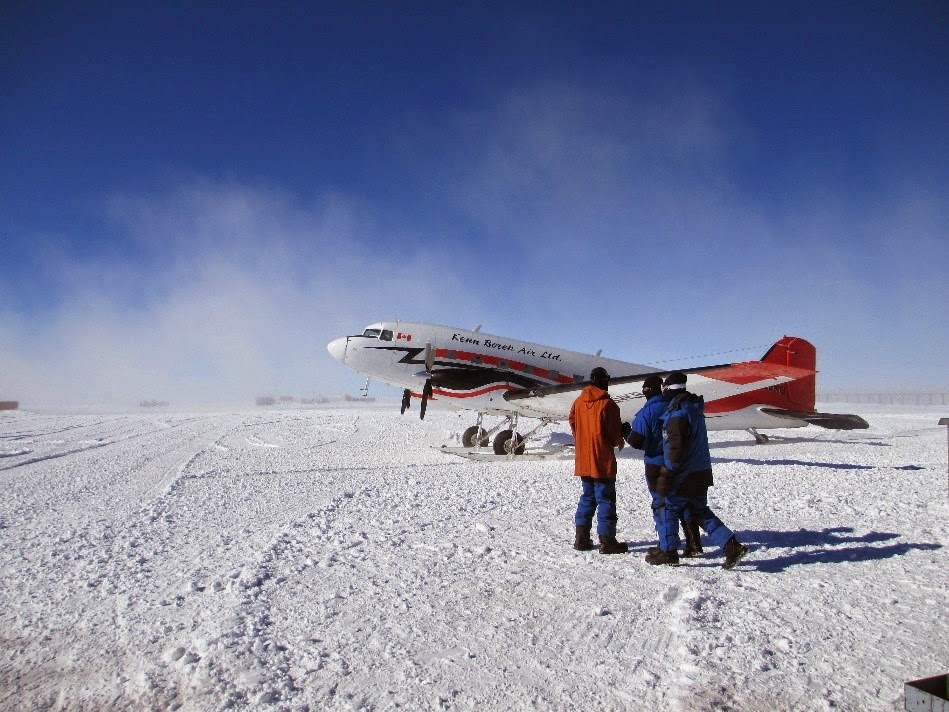


Pictures #83 and #84: The Bassler just landed and we are exhilarated to get fresh food!

And then, to work. The newly-arrived fresh food had to be carried inside and the newcomers were in no position for heavy-lifting (unlike the winter crew that was living on Dome C for a year, they had to re-adapt to high altitude, which debilitates physical strength). On the other hand, the fruits and vegetables could not remain on the ice! So we worked and worked until it was all safely inside.
During the long polar night, I never really felt that I missed the light – and yet I celebrated its return immensely. Similarly, it seems I had completely forgotten the pleasure of biting a fresh fruit, it never occurred to me profoundly that we lacked fresh food in the winter. Once again, the joy was greater than I would imagine when we tasted tomatoes, apples, peppers, olives, oranges and kiwi again. It was like our minds were unlocked and a storm of sensations sprang forth.
The summer is so different from the winter in so many untold ways. We now share the Station – which felt like our Station for a long time – with the summer crew. In the same time, it’s great to socialize with new people. The stress of being enclosed in a tin can with the same companions for a year has also evaporated. And as the summer progresses, we continue to notice the markers of our own impending departure. For most of us, it will be a permanent goodbye to Antarctica. The first plane has landed at Concordia. And soon another one will take us away.


Picture #85 (over): The Base full of (new) people, basking with life again.

Picture #86 (under): Already a package to receive with the first flight – ESA Lab material.

As a child I used to be quite a nostalgic person. I remember for example that I did not want to grow up like other kids of my age since I was having a good time right there, right now. One can argue of course that at the end of every “adventure” you only recall the nice moments. Under this effect, I definitely feel nostalgic already for having to leave the white vastness of Concordia behind very soon. Particularly because I have all the vivid colors of this last winter’s livelihood imprinted on my mind now: I remember where I was sitting when I spotted my first Aurora, what did we eat for Halloween and how it felt to walk to the Astronomy shelter surrounded by utter darkness. But I do not feel melancholy at any level. Just a sweet taste that comes with reminiscing… until we all embark on our next adventure.

In the end, what is life if not a meticulous collection of great experiences? I am thrilled to have added Concordia to this. With its arduous moments and its magnificent delights. . ҉

Tuesday, 28 October 2014

Concordia Base Log
By: Adrianos Golemis, ESA research MD

Time:  L+345 (October 2014)
Temperature: -45 ˚C
Week: 50
Sunlight: Continuous (dusk around midnight)

Morale: So-so

Log Entry #18 – Share

Alex McCandless (also known as “Supertramp”) had reportedly written that happiness is only real when shared. And sharing is important for other feelings, ideas and visions too. Ain’t that right?
Ϡ Supertramp (this time, the group!), “Bloody Well Right”:
These days our DC10 expedition has almost completed 365(.25) days in the white desert. Amazing to realize this – it’s another thing to expect it and another thing to reach the milestone. At some periods time seems to have passed so quickly. In part, because of this sharing of impressions (incoming and outgoing) with the rest of the world. Sharing the great moments among our crew and with our loved ones far away or discussing the hard times with friends inside and outside the Station.
In my opinion, one year in isolation can weaken some relations but strengthen others. It’s nearly a triage – which of them can survive in extremis? Distance and inaccessibility are not always show-stoppers. At least not when there is an end to them, the expectation of light at the other side of a year-long tunnel.


Picture #75 (left): Concordia phone booth – like Harry Potter’s “cupboard under the stairs”.

Picture #76 (right): The e-mail/computer room, a hub of personal communication with the outside, a bridge to the world.

Thanks to technology you can partially make up for not being there with your friends, family or partner. It’s true that we’ve missed a few weddings, births, funerals – not to mention birthdays and name day celebrations (which are as important as birthdays in Greece). But hopefully sharing our own unique experiences from Concordia acts as a counterbalance to that.
Can you keep your friendships alive from Concordia? Sure, if you actively keep in touch every now and then. Naturally, it depends on the other person too. But I am content that my bond with 2-3 close friends was actually reinforced during my stay in isolation. The same goes for my family.
Can you maintain a relationship with your partner from Antarctica? Sure, if you try a bit. And if it’s a mutual decision. In this case, living in separate worlds plays a more significant role. You must restrain yourself to telephone calls and occasional Skype videoconferences. No touch or common experiences for a year. Even calling can be difficult due to the rather inconvenient 6- or 7-hour  time difference with Europe. But pairs have survived before in similar or worse conditions (for example, in times of war). In the end it is a matter of dedication and determination. To keep the core of a relationship alive, to give and receive the fundamental things in life, as Billie sang.
Ϡ Billie Holiday, “As time goes by”:
{Edit: A couple of weeks after this text was written I received a package sent by my girlfriend, Judith, one year ago. It was a collection of cards, letters and gifts from many of my friends who following her suggestion devised this surprise for me, to keep me company over the forthcoming winter. This marvelous little package was stuck in another coastal Antarctic Station for approximately one year and only reached me at the end of the winterover. However, it still made me smile countless times and feel an inner warmth as I read messages and opened presents from France, Malaysia, USA, Greece, Italy, El Salvador, Ireland, Spain, Serbia, Russia, the UK, Canada, Australia, China, Finland, Germany, Brazil and other places. It was almost like a time capsule – thoughts, wishes and gifts prepared in November 2013 and opened one year later. I am greatly thankful to Jud and my family for this idea and to everyone that took part. Astronauts use the same trick while in long space missions – they take up with them artifacts and letters prepared by those close to them and open them one at a time for as long as the mission lasts. And speaking of astronauts…}
A few weeks ago we had the great pleasure to enjoy a live connection with… space. ESA astronaut Alexander Gerst held a videoconference with us at Concordia, with the kind support of NASA and ESA. For many of us and particularly me it was a unique experience and a little dream come true. We discussed a lot of subjects about life in space and life in Antarctica or in isolation in general. Alex had done his own share of living in Antarctica before being selected as an astronaut. Coincidentally, I had met him during his training for this mission (entitled “Blue Dot”) in Star City, near Moscow, Russia. That was on an educational trip with the International Space University and at that moment, naturally, I didn’t expect to talk with him during his stay in space. Then again, I didn’t expect to spend the next year at Concordia!


Picture #77 (over): Call to space from Concordia’s Living room – Alex’s face on the screen is not visible but judging from the position of his arms you can tell he's floating in 0g!

Picture #78 (under): With Alex and NASA’s Reid Wiseman in Star City about 2 years ago.

Alex’s sharing his experiences with us proved again to be something special. We also managed to send him some photos of our Station and the Auroras above it, hoping to kindle some nice memories on his side, making his day a bit exceptional too. Sharing experiences is generally of paramount importance for the space sector – it motivates young people to become active and pursue scientific careers and it explains the importance of ongoing space research and technology development in an era that this is not entirely clear to the public. Few people think for example that it is space technology which gave birth to the hospital MRI scans or that without satellites the GPS on their phone could never function. Even fewer consider that every euro invested in space has a reported return of 1.4 or remember that astronauts undertake a variety of medical experiments in zero gravity to find solutions for pathologies on the Earth. A bit like what we do at Concordia. And we need to share all these facts at a greater scale.
Outreach is vital – and often underestimated. This summer I was very happy to participate in a Greek “space art” competition for children and teenagers in Greece. If you‘re interested in the works, you can have a look at the link below. Some of them are truly captivating.
If you like science, space, art, whatever you are passionate about actually, share it! The effect of your ideas and feelings is multiplied when you share. And with them, share a smile. Sometimes there’s nothing more important than that, as you learn in a winterover.
This blog entry is heartily dedicated to all of you. All of you who follow this adventure and with whom I am happy to share a few unique moments of our life on the ice. Thank you – and looking forward to hearing back from you.  ҉


Sunday, 14 September 2014


Concordia Base Log
By: Adrianos Golemis, ESA research MD

Time:  L+308 (September 2014) 
Temperature: -59 degrees C
Week: 45
Sunlight: 12 hours

Morale: Great!

Log Entry #17 – Enhanced Imagination

He who has everything values nothing – and he who has nothing values everything”.
Perhaps surprisingly, this quotation does not stem from any grand historical study or religious treatise, but rather echoes from a book in Frank Herbert’s saga, Dune. It is a saying of the desert people who are deprived of many commodities in their everyday toil for survival and thus learn how to deeply appreciate every drop of bliss in their lifetime’s hourglass.
While it would be quite an exaggeration to imply that trapped in our desolation of ice we are bereft of as many luxuries in Antarctica, there is certainly some measure of comparison between the harsh life on the fictional planet of Arrakis and the lack of external stimulation at Concordia Station. So, it seems that like the desert people, we are learning slowly how to value more the tiny spices of life which together constitute the synthesis of our everyday routine.
I could argue vigorously that after ten months in Concordia, my imagination does really seem to have been enhanced. When I speak with my friends or family on the phone and they tend to describe a casual daily scene, my mind can unwittingly give birth to lush images or paint the ordinary details of a rainy street in the most extravagant of colours. Considering that we just went through what was summertime in Europe, every time I called my brother on a sunny Greek beach, a cataclysm of feelings burst inside my brain.
Just by hearing a simple statement such as “Hi, how are you? Me, I’m walking to work and it’s cloudy”, our intellect recreates the minutiae of the site, drawing from past memories and filling the gaps with imagination, in an almost artistic way. Many times I was taken aback by the wealth of simulated details that my mind renders to depict the background whenever I hear someone speak of the sea or of a mountain hike. It was particularly surprising to find myself subconsciously pondering about the tiniest filaments in the fabric of every scene that was communicated to me. In an enhanced way.
And again each time I hear a familiar song here at Concordia, my mind takes me back to where I first listened to it, reconstructing the fine points of the scene with accuracy, little things that I had never noticed at first and which could hint to the particularities of Proustian memory.
I can now picture the reflections of sunlight on the shimmering surface of cars as you hastingly stroll down the road on an early spring morning, so eager to catch the bus that you fail to notice the small droplets of humidity upon the leaves of trees. The smell of fresh bread coming from the open doors of bakeries when the weather is good and by contrast the odour of the wet soil when it rains. The contextual sounds of life in the city – not only the traffic, but also overhearing people who talk in the street below, briefly coming in and swiftly rushing out of your own continuum, as if in a Gus Van Sant movie. The hissing of the wind, the annoying horn of a truck and the ring of a bicycle. The golden shades of a summer afternoon and why is the sky so fundamentally different from a pinky-orange afternoon in the winter. Noise of insects (haven’t seen one of any kind for about a year now). The tactile impression of warm sand swishing through your fingers. The refreshing feeling that a cool cocktail endows upon your throat when it’s warm and the chill that inevitably crawls under your coat on an autumn day. These might be petty nuances of just another day for you, but they gradually begin to bear a startlingly profound importance to me.
At times I miss even unpleasant manifestations of stimulation, just because they complete the rich spectrum of what we can sense with every breath we draw. Things like the smell of garbage, the annoyance of sweat or the thundering rumble of a storm that prevents your sleep in the night. Above all, the hues of green have a staggering effect on me whenever I bump onto them, in photographs or other media. The real, natural green would be what I definitely miss the most here in the white continent – and not because it happens to be the colour of my favourite sports team. A trick to keep myself connected to the rest of the globe is watching films shot in lavish locations – from Iceland to India, the Pacific, China, and Turkey, observing and absorbing the canvas of each locality can rejuvenate your mood.
For my part, I anticipate that this experience at Concordia will be a didactic one, also from this viewpoint which was admittedly unforeseen in its intensity. Perhaps tasting again the abundance of reality after the end of our isolation will be a feeling similar to enjoying a grandiose meal after months of fasting. Treasuring each and every ingredient that builds up to our perception of the cosmos in the greatest and most insignificant moments. Incidentally, “cosmos” means “jewel” in my native tongue. Having now missed this cosmos substantially myself, it would be comforting to think that people deprived of their sight or hearing-impaired can also enjoy the world around us in part by depending on such a method of “enhanced imagination”. Or by translating what they cannot physically grasp with senses into forms and tones that they can apparently perceive in greater ways than most of us.
By the way, today’s Log Entry was willingly arranged to not include any pictures as the previous ones had. Not easy to read line after line without a break of colour and image, is it?! Yet now perhaps you can close your eyes and envision all that you have read about or all that is dear and holds meaning for you. Unlike a provided picture, it is much harder to engage continuously in this activity – but your interpretation of every scene will be unique and personalized. We could say that such is the difference between reading a book and watching a motion picture. Constructing your own reality instead of receiving one. After all, the great William Blake embraced imagination as “human existence itself”.
I hope you enjoyed this little exercise. Welcome to our world of Enhanced Imagination. ҉
Ϡ http://www.youtube.com/watch?v=sMmTkKz60W8 : “Simple kind of man”, by Lynyrd Skynyrd.

Tuesday, 26 August 2014

Concordia Base Log
By: Adrianos Golemis, ESA research MD

Time:  L+289 (August 2014)
Temperature: -51˚C
Week: 42
Sunlight: The Sun is back – 4 hours of light/day
Morale: Generally good, at times concerned

Log Entry #16 – One

As is the case in the last 10 months, I am writing these lines from a remote research Station in the core of the Antarctic continent, benefiting from a bold move on behalf of humanity to defy the adverse conditions of Antarctica, united, and to establish its year-long presence at hostile environments, to conduct science.

Our Station bears the symbolic name of Concordia. Yet during our stay here these past ten months, several alarming events have come to pass around the globe that we call Earth, our home. We have read the news that travel through air and space, re-emitted by satellites to reach even to our distant outpost: Hostage crises in Africa. Near-civil war in Ukraine. Hundreds of victims in the Gaza Strip. And sadly more.

Ϡ Guns ‘n’ Roses (let’s stick with the roses!) – Civil War: https://www.youtube.com/watch?v=JYoIgKxOK4A

For someone who is overwintering in Antarctica, dependent on the assistance of colleagues locally and far away, living on the pinnacle of the coordinated efforts of many nations, such events of violence seem not only sad, disappointing, regrettable, but also (and perhaps more importantly) pointless.

It is not only an emotional or moral argument to raise against survival of the fittest and dominance by force. History has proven time and again that in spite of the impulse of many living beings to resort to violence in order to resolve their differences, partnership works to everyone’s advantage at the end. This is the reason that alliances of diverse populations have risen throughout the centuries: from the Athenian Coalition to Kalmar and the European Union.

And history proves that point again today: The magnificent advancements in science and technology, whose ameliorating effect on our everyday lives we often neglect, happen to a great extent because of cooperation and sharing. I seriously doubt that we could sustain continuous human activities in space if it weren’t for joining forces and exchanging knowledge among many countries, some of which used to be major enemies. And the same goes for us, the thousand souls that constitute the population of Antarctica.

Violence is the short, easy way. Tolerance and collaboration is the harder one – but it definitely bears more fruit if one is wise enough to invest in it.

Concordia Station in particular is a prime example of what cooperation can achieve. Concordia is the only multinational research station in the seventh continent – and it functions well despite the complications inherent in any form of collaboration. Undoubtedly the combined efforts of the two countries that operate it – France and Italy – amount to much more than any could achieve alone.

Synergy is a word derived from my native language, Greek, which means that the parties working together accomplish more in teamwork than what the sum of their individual efforts could realize.


Picture #73: Concordia flags in formation, harmony in union.

Co-existing and working together is not as easy as doing whatever one wishes, true. Here in Concordia, yes, there are differences between us crewmembers. Yes, we do go through tense phases occasionally and we do argue. In the end of the day, however, we realize the need to live together peacefully, cooperate, and tolerate. Perhaps if everyone went through an Antarctic winterover experience, they could understand this need more easily. And behave accordingly. But maybe you could take our word for it, too.


The same goes for the world and its wars. Yes, great interests, financial, political exist. Yes, the citizens of this world are fundamentally so much different. But ten months of living isolated in one of the world’s hardest environments can teach you to get the best out of everything and everyone, however divergent from your standards they appear to be at first. The world is a colorful mosaic for a good reason and there is profit to be found in this rich diversity if one is patient and perspicacious.

The name of our Station is Concordia and its etymology comes from Latin: Con-, together, and –cordia, heart. The word “cordially” derives from the same root in English and so does the French expression “cordialement”, at the end of every letter. “D’ accord” in French literally means “I am in accordance, aligned with your thought”. It is perhaps fitting for a Francoitalian base to be named like that; the name itself coming from Latin, but so eminent in modern French culture, in the names of sites such as Place de la Concorde or even the joint effort to build the Concorde airplane with the British.

One winterover in Antarctica can make you understand the real necessity for respect and sharing that the term “concordia" implies. And abolish thoughts of war that generates victims in the name of difference.

To reverse U2’s lyrics, “we‘re not the same, but we are One”.
That’s what we are taught in Antarctica. Now, let’s apply it to the world.

In our case, here we are, all in one, differences aside:


Picture #74: Concordia DC10 mission group photo.

We are determined. We are together.

We are Concordia. ҉ 

Wednesday, 30 July 2014

Concordia Base Log
By: Adrianos Golemis, ESA research MD

Time:  L+258 (July 2014)
Temperature: -63˚C
Week: 38
Sunlight: Faint glow below the horizon
Morale: With a lot of changes…

Log Entry #15 – The Highs and the Lows

Life at Concordia is not always perfect.

That much you can picture by reading any book concerned with life in extreme conditions, isolation and confinement in particular. After 9 months surrounded by ice, I can tell that there is a difference between reading about it and living it. The highs and the lows, both are now not distinct situations that you try to imagine as you flip through the pages of a scientific magazine, but rather personal experiences.

If you live in the same few square meters even with your best friends for one year, you are bound to feel some friction at times. We do our best to avoid that and respect each other’s personal habits, space and individuality. Yet at some occasions this becomes increasingly difficult if ones considers the other adverse effects of Concordia’s environment.

Ϡ Riuichi Sakamoto, “Forbidden Colours”: https://www.youtube.com/watch?v=kf0HYeQp760

The continuous night does not seem to have such a significant direct effect on us, but then again there are days that you wake up in a grim mood. More important probably is the influence that lack of sleep has on our everyday life. Due to the severe lack of humidity, low pressure as well as circadian desynchronization, we all experience some varying difficulty in falling asleep or maintaining sleep for a normal duration. Instead for a period of a few weeks it was common for some crewmemebers to wake up a multitude of times or be completely unable to rest. If this form of insomnia is sustained for a few days, you can find yourself somewhat more irritable than usual.

Another effect one might notice is that around the middle of the 3-month long night it is generally more difficult – mentally – to complete tasks or take initiatives. Perhaps this is because external stimulation is minimal and indeed a simple walk to the park could seem like an oasis of sensations that we miss (smell, colors, natural sounds, scenery) and which could easily rekindle our interest in small or greater errands. Unfortunately, for the time being, we cannot entertain this possibility.

Naturally, we try to develop “countermeasures” to deal with these circumstances. Talking problems through usually proves effective. To counter the lack of external stimuli, we try to celebrate every occasion, such as birthdays or national holidays. Midwinter (21st of June, winter solstice) was a monumental occasion on which all Antarctic Stations go on vacation to enjoy what marks the middle of our stay in isolation. Bases exchange international wishes for a happy second half and organize each a few events and happenings. If you endure half, the other half is just counting backwards…


Pictures #65 and 66: Celebrating Easter – Easter eggs painted by Igor and me, with accompanying wish card.

Yet it would be erroneous to depict our current situation as a miserable one. Life in isolation can help you to deeply understand the challenges, but also familiarize with techniques to endure and cope with them. And on top of that, there are always very pleasant surprises. And small, unique things to enjoy.

For example, static electricity due to extreme dryness is a constant annoyance here. But one funny thing that always beguiles me is sparkles in the night. Indeed it is very irritating to feel a little burn every time you touch a surface around you (especially if you wear a lot of clothing). But it is equally amusing to spot the sparkles of static electricity on your blanket as you switch off the lights and get in bed every night: You cover yourself and the simple touch of the blanket as you pull it over you creates little lights, strong enough to illuminate the space around you for a portion of a second. Almost like fireflies playing around your room. A good substitute, since we haven’t seen an insect of any kind for the better part of a year!

When I find it impossible to sleep in the night, one of my favorite occupations is night raids! This basically means that two or three of us creep in the kitchen and enjoy some after-midnight snack or drink. It is a funny activity and a relaxing one. Our midnight company was particularly active during the football World Cup (which we could not really view due to internet limitations, but watching the scores was fun).

Sleep is a frequent conversation topic that we engage in daily. It’s almost like asking “how are you”? Other than that we do occasionally speak about events in the outside world, like the results of the European elections, or about more personal matters.


Pictures #67 and 68: Playing team games and enjoying intercultural dinners – in this case, Mexican.

As said, birthdays are important incidents to refresh us, with our chef, Giorgio, meticulously preparing a special dish, while members of the technical team always come up with an interesting, handmade gift.


Picture #69 (left): Enjoying my handmade Antarctic ESA rocket – compliments to my colleagues at Concordia! Picture #70 (right): Midwinter vacation at its prime – Game of Thrones themed dinner [Credits T. Ceraolo].

Life in the base might generally appear to be very monotonous to outsiders – and at times, it can be. Originally this lack of external stimulation is pleasant because you find some time to do all the things that you always had in mind but never dedicated an evening to. You will read that book that was progressively collecting dust in your upper shelf and complete tasks that the hustle and bustle of metropolitan life never allowed you to. Yet, after a few months, the excitement that you draw from them will slowly be depleted. It is at this point that an entirely new activity might help you carry on smoothly. In the same books that describe isolation psychology, one can read also about the phenomenon of salutogenesis. It is the positive effects that a special experience can have on the human body and mind, even on health. For example, astronauts go through this when they view the Earth – the entirety of our world – from space. For us here photography – and especially of the skies – seems to have a similar result.

With the excuse of having to adjust the camera box and tripod usually placed at the roof of the Station, I was motivated to exit the base many more times than I used to, especially in the night. This had an invigorating effect on me. It’s amusing to see Orion “upside down” time and again. When you go out, the psychedelic embrace of the Night is always unique. You never grow tired of that as you exit the hatch at the roof of Concordia to position the specially modified frost-resistant camera and capture a portion of the celestial orb’s magnificence.

Ϡ Wishbone Ash, “Persephone”: https://www.youtube.com/watch?v=Xn66BO2E3rk

You can hear only your respiration through the little breathing mask that partially prevents your visor from fog. Then you look around after closing the hatch… There is nothing. Only total darkness that devours you. For 1 or 2 seconds you feel alone and threatened. Perhaps some primordial reflex to darkness…

Then you raise your eyes and look up and you pinpoint three thousand little stitches in the sky. The Milky Way is very prominent. And gradually your eyes adjust to the dark. You start to feel the freezing winds creep inside your polar suit through the tiniest holes to burn your skin. But you feel content. Starlight is all that illuminates the infinite white of the plains around you. After all, let’s not forget that we live under the darkest, most pristine skies of our planet. Concordia could easily qualify as Night Capital.
  

Pictures #71 and #72: Our custom-made box, to insulate the camera and allow us to take photos outside.

As the days go by, slowly the Night recesses, giving more and more ground to the illuminating powers of the advancing Day. Actually today was the first time in four months that I woke up by the touch of morning light on my face.

Looking at the orange glow painting the horizon with colors again at midday generates a heart-lifting feeling. Still in the case of a few of us here, the day seems to be approaching too fast, gradually marking the end of our southernmost adventure. The feeling is bittersweet.

See you all soon and – for as long as it lasts – good night from Night Capital. ҉